That Vet Nurse Life
Veterinary Nursing Multi-Parameter Monitoring Guide | ECG, Capnography, Blood Pressure + SpO2 | A5 Vet Nurse Revision
Veterinary Nursing Multi-Parameter Monitoring Guide | ECG, Capnography, Blood Pressure + SpO2 | A5 Vet Nurse Revision
Couldn't load pickup availability
Share
Multi-Parameter Monitoring | A5 Veterinary Nursing Revision Guide
A compact veterinary nursing revision guide covering the key parameters commonly monitored during anaesthesia and critical patient care.
Designed to help veterinary nursing students understand not just what the monitor displays, but what the readings mean and what to do when something doesn't look right.
The guide emphasises that multi-parameter monitors provide useful objective information, but readings should always be interpreted alongside hands-on patient assessment rather than replacing it.
Inside the guide:
Multi-parameter monitoring basics
Setting up + calibrating the monitor
Record keeping
Pulse oximetry
SpO₂ values
Probe placement
Causes of inaccurate SpO₂ readings
Nursing actions for low SpO₂
Blood pressure monitoring
Correct cuff placement + sizing
Systolic, diastolic + mean arterial pressure
Oscillometric blood pressure
Doppler blood pressure
Step-by-step Doppler technique
Nursing actions for hypotension
Nursing actions for hypertension
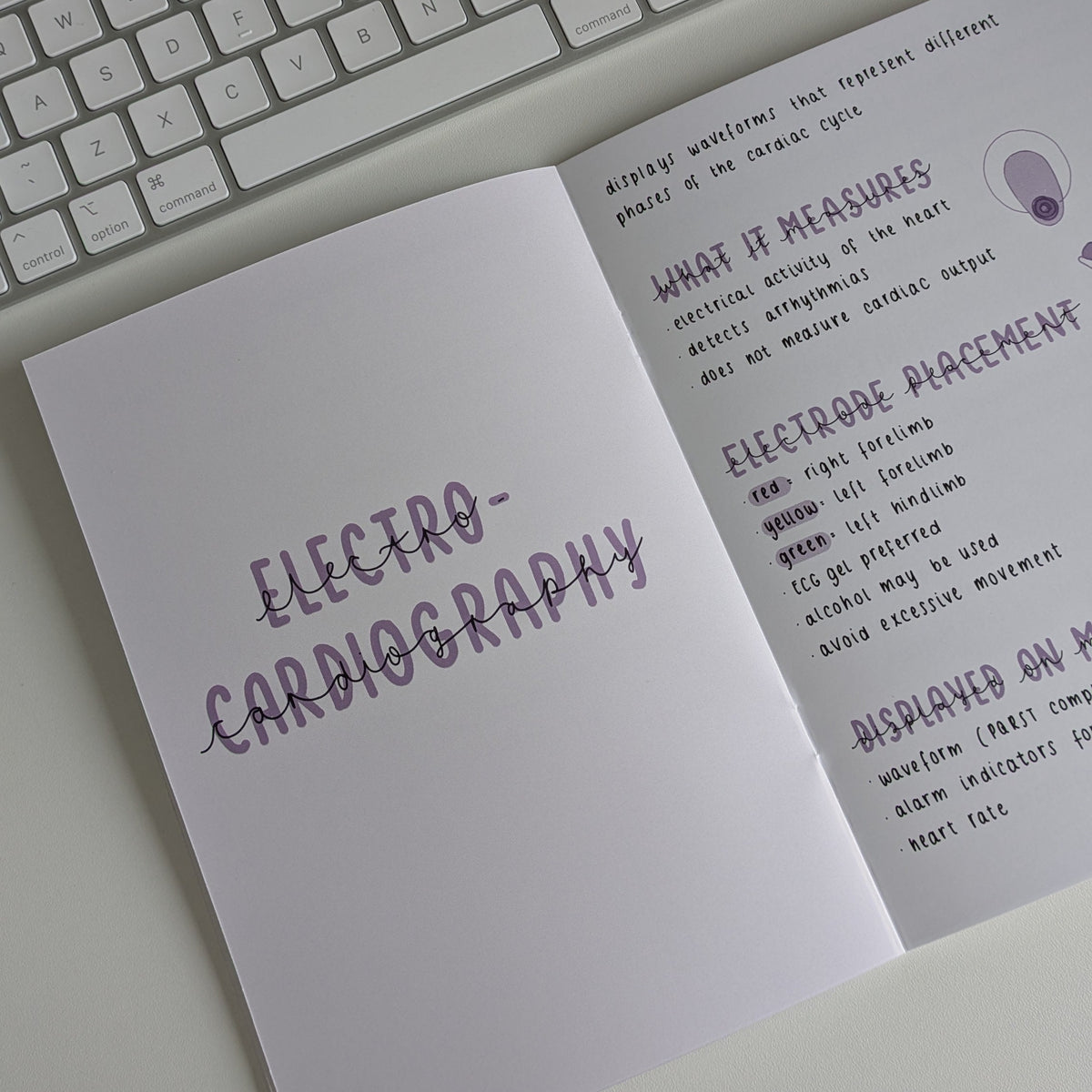
ECG monitoring
Electrode placement
Normal sinus complexes
P wave, QRS complex + T wave
ECG abnormalities
Common ECG trace examples
Capnography
ETCO₂
Mainstream + sidestream capnography
Normal capnograms
Common capnography waveform changes
Hypercapnia + hypocapnia
Nursing actions for abnormal ETCO₂
Pulse oximetry
The pulse oximetry section explains what SpO₂ measures, common probe sites and what to check when interpreting the reading.
It also looks at causes of inaccurate readings — including poor perfusion, hypothermia, movement, pigmentation and equipment interference — alongside practical nursing actions if SpO₂ drops.
Blood pressure
The guide covers correct cuff placement, including appropriate cuff sizing, alongside systolic, diastolic and mean arterial pressure.
Both oscillometric and Doppler techniques are covered, with a step-by-step illustrated guide to obtaining a Doppler blood pressure reading.
It also looks at practical nursing actions when a patient becomes hypotensive or hypertensive, helping connect the monitor reading with assessment of the actual patient.
ECG
The ECG section covers:
What an ECG measures
Electrode placement
What to assess
The normal sinus complex
P wave
QRS complex
T wave
Abnormal traces
Example arrhythmia traces
The guide includes hand-drawn examples of a range of ECG rhythms and abnormalities for visual revision.
Capnography
The capnography section covers what ETCO₂ represents, mainstream vs sidestream monitoring and how to interpret changes in the capnogram.
Example waveforms include a normal capnogram, airway obstruction, cardiogenic oscillations, hypercapnia, decreasing ETCO₂ and rebreathing.
Practical nursing actions are also included for both high and low ETCO₂ readings.
Product details
Format: Physical veterinary nursing revision booklet
Size: A5
Topic: Multi-parameter monitoring
Suitable for: Student Veterinary Nurses, Veterinary Nurses and anyone looking to refresh their anaesthetic monitoring knowledge
Perfect for
📚 Exam revision
🩺 Clinical placement
💻 Understanding the multi-parameter monitor
❤️ ECG revision
🫁 Capnography revision
🩸 Blood pressure + SpO₂ revision
Please note: This is a physical product and will be posted to you. It is not a digital download.
For educational and revision purposes only. Monitor readings should always be interpreted alongside clinical patient assessment and appropriate veterinary direction.